
2025-2026 BILLS
Learn about the bills we are supporting and opposing this legislative session and take action.
HEARINGS HAVE BEEN SCHEDULED
DATE: Friday June 6th 2025
TIME: 10am – 5pm
LOCATION: Gardner Auditorium, MA State House, 24 Beacon Street, Boston MA
TESTIMONY DETAILS: Each person has 3 minutes to give verbal testimony for all the bills these support/oppose. We recommend that everyone submit written testimony.
THE DEADLINE TO PRE-REGISTER FOR VERBAL OR IN-PERSON TESTIMONY HAS PASSED. HOWEVER, IF YOU STILL WISH TO TESTIFY, YOU ARE ENCOURAGED TO ATTEND THE HEARING AND SIGN UP ON-SITE FOR SAME-DAY TESTIMONY.
SAME DAY SIGN-UP FOR IN-PERSON TESTIMONY ONLY – IF TIME ALLOWS: Individuals who miss the deadline to pre-register for testimony may appear on the day of the hearing and sign-up to speak in person on forms provided by committee staff outside of the hearing room. Time permitting, when all pre-registered individuals have been called to testify, the Chairs will then call any individuals who sign-up on the day of the hearing.
WRITTEN TESTIMONY: If you would like to provide written testimony, please include the bill number in the subject line of the email, as well as your name, address, phone number, and organization, if any, on the submitted testimony. Written testimony is encouraged and will continue to be accepted after the hearing until the relevant bill is acted upon. Such testimony may be submitted via email to JointCommittee.PublicHealth@malegislature.gov. Please include “Public Health Committee Testimony, [Relevant Bill Number]” in the subject line of the email. Those who plan to submit only written testimony may do so before or after the signup deadline. Once again, those submitting written testimony should be aware that all written testimony submitted will be read by committee members and staff and may be made available for public review on the Legislature’s website.
URGENT ACTION ITEM: Tell Lawmakers: Remove the “Elevated Risk” Pilot from Budget Line Item 4516-1000
Senator Rebecca Rausch has quietly embedded language from her discriminatory and widely opposed Community Immunity Act (S.1618) into the FY2026 State Budget—specifically within Line Item 4516-1000 of Senate Bill No. 2525.
This marks the fifth time she has attempted to push this controversial provision through the budget process—bypassing public hearings, stakeholder input, and legislative debate.
Key Concerns
1. Misleading Framing and Disproportionate School Burden
This amendment imposes a state-created designation, mandates public notification, and enables forced presentations—all without local consent. The burden would fall hardest on underfunded schools with high percentages of:
High-needs students
Students with disabilities
English language learners
Low-income and homeless populations
Religious, special education, and small schools would be disproportionately affected. Publicly labeling a school as “elevated risk” invites stigma and may drive families away, undermining trust and enrollment.
2. Public immunization data is already available at mass.gov/info-details/school-immunizations, where families can view school-level data for the 2024–2025 academic year and past years. Lower immunization rates may reflect access issues, not opposition.
3. No Public Process or Transparency
This policy was inserted into the budget without public hearings, stakeholder input, or expert testimony. Embedding controversial mandates in fiscal legislation circumvents democratic process.
4. Sets Up Framework for Future Student Exclusion
While this amendment does not currently authorize student exclusion, it lays the groundwork for such action. The infrastructure it creates mirrors language used in broader legislative efforts to exclude students with exemptions, even in the absence of outbreaks or emergencies.
5. Threat to Special Education and At-Risk Students
Programs under Chapter 766 serving medically complex or vulnerable students could face serious harm. Designating their institutions as “elevated risk” undermines protections under IDEA and Section 504 and invites unjustified scrutiny.
6. Misallocation of Public Health Resources
DPH resources should be used for meaningful services and outreach, not for developing classifications that label and stigmatize schools without any clear public health trigger.
7. Mental Health and Community Trust
This amendment creates a climate of fear and division. Labeling schools in the absence of health emergencies causes anxiety for students, families, and staff—especially those with valid exemptions. Instead of building trust, it encourages targeting, isolation, and mental health challenges.
Our Position
Health Action MA strongly supports public health measures rooted in equity, education, and community engagement. This amendment does none of those things. It stigmatizes schools, misuses public health authority, and bypasses the legislative process.
We respectfully urge the Committee to:
Remove this language from Line Item 4516-1000 of Senate Bill No. 2525;
Reject the use of policy-by-amendment tactics to insert controversial mandates into the state budget;
Ensure full transparency for all immunization-related policies through proper legislative channels.
Massachusetts families deserve open, honest, and thoughtful policymaking.
Please stand for integrity and protect our schools and children from coercive and harmful labeling policies.
BE INFORMED. BE EMPOWERED. BE HEARD.
On this page, you’ll find everything you need to understand and take action on the bills that matter most during the 2025–2026 legislative session.
We’re breaking it all down for you:
- Which bills we support or oppose
- Bill numbers, summaries, and sponsors
- The current status, committees and key updates
- Direct links to full bill text and trusted, fact-based resources
- And most importantly—how you can take action!
Your voice matters. Let’s make sure it’s heard.


AN ACT RELATIVE TO FAIR EDUCATIONAL PRACTICES
COMMITTEE:
Joint Committee on Education
BILL STATUS:
H.641 — Remains in committee.
S.349 — Accompanied a study order, see S.2792 .
In Massachusetts, “sent to study” generally means the bill does not advance during the current legislative session.
Disclaimer: This overview is intended as a general guide to the legislative process. Deadlines and procedures are subject to change under Joint Rules, committee extensions, or other legislative actions.
BILL SYNOPSIS:
An Act Relative to Fair Educational Practices seeks to close what supporters describe as a longstanding gap in Massachusetts civil rights law by extending anti-discrimination protections to students throughout their enrollment at colleges and universities.
Current Massachusetts law under Chapter 151C primarily addresses discrimination during the admissions process and protects against discrimination based on:
- Race
- Religion
- Creed
- Color
- Sex
- National origin
Supporters of the legislation argue that once students are enrolled, Massachusetts law lacks comprehensive state-level protections addressing discrimination during a student’s academic experience, including protections specifically related to disability or medical status.
The bill would extend protections throughout a student’s enrollment and add a new protected category described as “special medical status.”
This category would include:
- Disabilities as defined under the Americans with Disabilities Act (ADA)
- A student’s condition based on receiving — or declining — preventive, curative, or palliative medical treatments
Supporters state that the legislation would establish clearer state-level protections for students with disabilities and students navigating medical decisions, while opponents have raised questions about how broadly “special medical status” protections could be interpreted in practice.
The bill’s stated purpose is to ensure students can pursue their education free from discrimination and with equal protection under Massachusetts law.

AN ACT PROHIBITING HARMFUL FOOD DYES IN COMPETITIVE SCHOOL FOODS
COMMITTEE:
Joint Committee on Public Health
CURRENT BILL #:
S.1531
|
H.2496
BILL STATUS:
H.2496 — Accompanied a study order, see H.5234 .
S.1531 — Accompanied a study order, see S.2790 .
In Massachusetts, “sent to study” generally means the bill does not advance during the current legislative session.
Disclaimer: This overview is intended as a general guide to the legislative process. Deadlines and procedures are subject to change under Joint Rules, committee extensions, or other legislative actions.
BILL SYNOPSIS:
An Act Prohibiting Harmful Food Dyes in Competitive School Foods seeks to prohibit the sale or provision of competitive foods and non-sweetened carbonated water containing certain artificial food dyes — including Blue 1, Blue 2, Green 3, Red 3, Red 40, Yellow 5, and Yellow 6 — in Massachusetts public schools.
The bill includes exceptions allowing the sale of these products off school premises, beginning 30 minutes after the school day ends, or during school-related activities such as booster sales, concession stands, and fundraising events.
Supporters argue the legislation is intended to improve the nutritional quality of foods available to students during the school day and reduce exposure to certain artificial additives in school environments.
Advocates also describe the bill as a step toward promoting healthier school food standards while still preserving flexibility for extracurricular activities and community fundraising efforts.

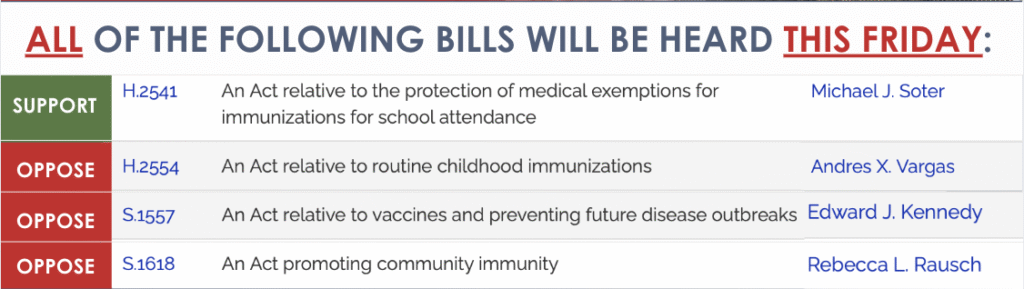
AN ACT RELATIVE TO THE PROTECTION OF MEDICAL EXEMPTIONS FOR IMMUNIZATIONS FOR SCHOOL ATTENDANCE
COMMITTEES:
S.347 — Joint Committee on Public Health
H.2541 — Joint Committee on Public Health
CURRENT BILL #:
S.347
|
H.2541
BILL STATUS:
H.2541 — Accompanied a study order, see H.5235 .
S.347 — Accompanied a study order, see S.2790 .
In Massachusetts, “sent to study” generally means the bill does not advance during the current legislative session.
Disclaimer: This overview is intended as a general guide to the legislative process. Deadlines and procedures are subject to change under Joint Rules, committee extensions, or other legislative actions.
BILL SYNOPSIS:
An Act Relative to the Protection of Medical Exemptions for Immunizations for School Attendance seeks to broaden and clarify the factors physicians may consider when evaluating medical exemptions for school immunization requirements. The bill would allow physicians to assess a child’s overall health circumstances when determining whether an exemption is appropriate.
The legislation would also provide protections for physicians issuing medical exemptions by shielding them from potential professional or disciplinary repercussions related to those decisions.
In addition, the bill would preserve existing Massachusetts law regarding religious exemptions for school immunization requirements.
Supporters argue the legislation is important for protecting individualized medical decision-making, physician discretion, and parental involvement in healthcare decisions affecting school-aged children.


AN ACT RELATIVE TO ROUTINE CHILDHOOD IMMUNIZATIONS & AN ACT RELATIVE TO VACCINES AND PREVENTING FUTURE DISEASE OUTBREAKS
COMMITTEE:
S.1557 – Joint Committee on Public Health
CURRENT BILL #:
H.2554 | S.1557
BILL STATUS:
H.2554:
On 4.15.2026, the Joint Committee on Health Care Financing recommended “ought to pass” and referred the bill to
House Ways and Means.
On 4.15.2026, the Joint Committee on Health Care Financing recommended “ought to pass” and referred the bill to House Ways and Means.
For H.2554 to pass, typically:
- It must receive a favorable report from House Ways and Means
- Pass second and third readings and a floor vote in the House
- Move to the Senate, where it would likely go to Senate Ways and Means, then Steering & Policy, and finally a Senate floor vote
S.1557:
Accompanied a study order, see
S.2888.
In Massachusetts, “sent to study” generally means the bill does not advance during the current legislative session.
Disclaimer: This overview is intended as a general guide to the legislative process. Deadlines and procedures are subject to change under Joint Rules, committee extensions, or other legislative actions.
BILL SYNOPSIS:
The proposed legislation would prohibit children from attending public, private, or charter schools if their families object to vaccination based on sincerely held religious beliefs — a significant change to longstanding religious accommodation policies in Massachusetts.
The bill follows the trajectory of California’s vaccination framework, which began with eliminating religious exemptions and later expanded oversight and scrutiny of medical exemptions.
Without a religious exemption, families declining vaccination on religious grounds may be left with homeschooling as their only option — regardless of a child’s educational needs, IEP status, or ability to thrive outside a traditional school environment.
The bill requires all public, private, and charter K–12 schools to annually report immunization and exemption totals to the Department of Public Health. It also directs the Department to publicly release aggregate immunization and exemption data by individual school, district, municipality, county, or other geographic area.
By centralizing and publicizing exemption data, the legislation could increase state oversight of medical exemptions and create pressure for additional review or standardization in the future.
Students with disabilities, complex medical conditions, trauma histories, or individualized educational needs could face increased challenges related to educational access, accommodation, or exemption review.

AN ACT PROMOTING COMMUNITY IMMUNITY
COMMITTEE:
Senate Ways and Means
CURRENT BILL #:
S.3070
(Previously
S.1618
&
S.2623)
BILL STATUS:
S.3070 — On 5.18.2026, the Joint Committee on Health Care Financing recommended “ought to pass with an amendment,” substituting a new draft, see S.3070 . The bill was then referred to Senate Ways and Means .
Disclaimer: This overview is intended as a general guide to the legislative process. Deadlines and procedures are subject to change under Joint Rules, committee extensions, or other legislative actions.
BILL SYNOPSIS:
The Community Immunity Act purports to improve and standardize immunization reporting but extends well beyond reporting requirements. The bill would significantly expand state oversight of immunization policy while creating new compliance, reporting, operational, and exclusion-related burdens for students, families, schools, childcare programs, camps, colleges, and healthcare providers.
This legislation applies to:
- Public schools
- Private and parochial schools
- Charter schools
- Homeschool students participating in school activities, programs, or athletics
- Daycares, childcare programs, and preschools
- Family childcare homes
- Recreational camps
- Public and private colleges and universities
- Students with medical or religious exemptions
Key provisions of the bill include:
- Provides that exemptions are valid for one year only
- Mandates immunization and exemption reporting by all “covered programs” (generally including schools, colleges, daycares, and camps)
- Designates covered programs as “elevated risk programs” if they fail to report data or if immunization levels fall below state-defined herd immunity thresholds
- Gives the DPH Commissioner discretion to exclude students from elevated risk programs if they are not immunized according to the state schedule — including students with medical or religious exemptions
- Expands exclusion authority during outbreaks by allowing the DPH Commissioner broad discretion to exclude unvaccinated students if there is a “potential epidemic” within the geographic area that includes the school or program
- Allows private covered programs to impose vaccine requirements stricter than those required by the state, including potentially requiring additional vaccines not mandated by Massachusetts
- Permits private programs to potentially refuse religious or medical exemptions
- Requires elevated risk programs to be publicly listed on the DPH website, notify families of their designation, and potentially host immunization information sessions
- Requires DPH to provide informational statements that covered programs must distribute to families
- Expands Massachusetts minor consent law by allowing minors to consent to preventative care, including vaccination, without parental knowledge or consent and without clearly defined intellectual capacity safeguards
- Mandates DPH collection of immunization and demographic data and requires daily immunization reporting during public health emergencies
- Grants DPH broad implementation and enforcement authority related to these provisions

AN ACT ENHANCING ACCESS TO ABORTION CARE
COMMITTEE:
Joint Committee on Health Care Financing
CURRENT BILL #:
S.1244
|
H.1815
BILL STATUS:
Hearing held on November 18, 2025.
S.1244 — On 5.14.2026 the bill was reported favorably by the Joint Committee on the Judiciary and referred to the committee on Health Care Financing .
H.1815 — Accompanied a study order, see H5281 (under House Rule 27).
In Massachusetts, “sent to study” generally means the bill does not advance during the current legislative session.
Disclaimer: This overview is intended as a general guide to the legislative process. Deadlines and procedures are subject to change under Joint Rules, committee extensions, or other legislative actions.
An Act Enhancing Access to Abortion extends beyond abortion-related care by allowing minors to consent to preventative medical care — including vaccinations and sterilization — without parental knowledge or consent.
The legislation does not establish specific age thresholds or clearly defined mental capacity standards for minors making these healthcare decisions independently.
Supporters describe the bill as expanding confidential healthcare access for minors, while opponents argue it significantly reduces parental involvement in major medical decisions affecting children.
Critics also raise concerns about informed consent, oversight, and whether minors should be permitted to authorize potentially irreversible medical interventions without family participation or guidance.